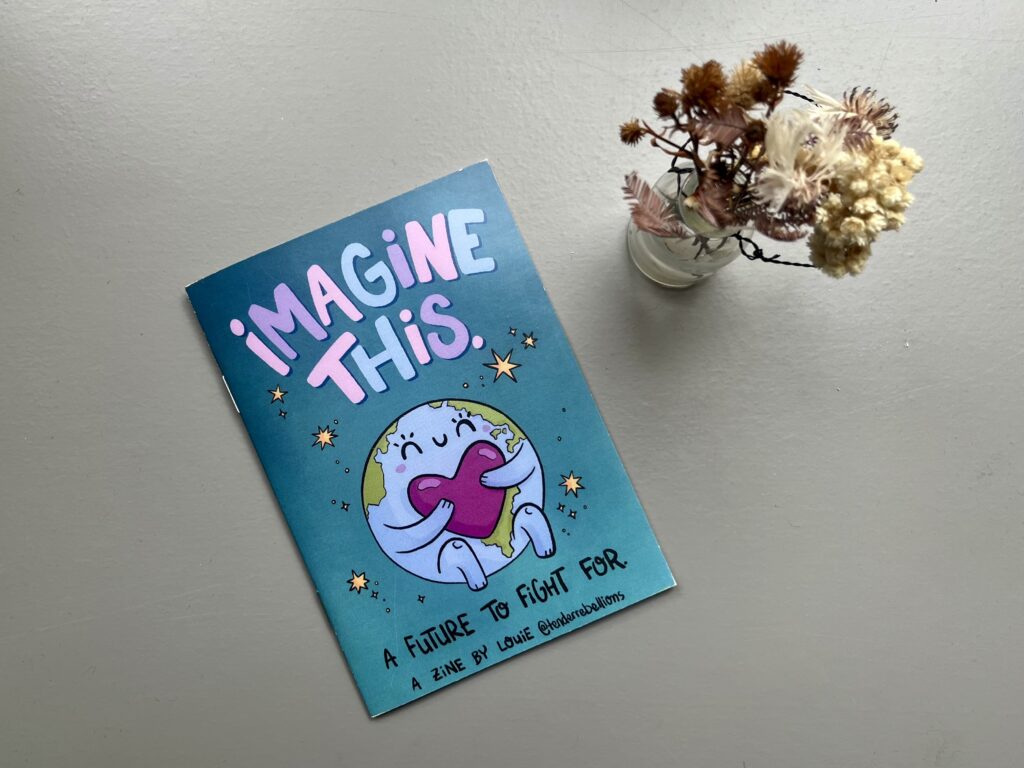
I’d been carrying the idea of a zine library around with me for a long time. Somehow, though, I never quite found the starting point to actually get going. Then, in February/March 2026, it happened: I went looking for a specific zine about imagining and shaping positive futures. At first I wasn’t even sure whether I actually owned it or had only seen it online. Digging through the depths of my zine boxes, I eventually found it:
My first instinct was to set up an Excel spreadsheet and enter all the zines from my collection. But since I work in academia and already use Zotero there, I thought: why not sync my personal Zotero (nonfiction and fiction) with my work Zotero (academic articles, nonfiction, etc.)? And add another collection in Zotero just for zines?! That way everything would be in one place — on my computers and on my phone.

Zotero
Zotero lets you collect and organize sources, information, notes, and related documents. For a first look at Zotero, I recommend the blog post „Getting started with reference management“ on tub.torials.
Syncing across devices worked flawlessly, and the „ZINEtero“ collection was quickly set up as a sub-collection within the „All about Zines, Baby“ collection. With „ZINEtero,“ I also had a nice project name right away. So far, so good.
Zines are basically the nightmare of any classic cataloging software.
From the start it was clear to me that I couldn’t just enter zines „as is.“ What I hadn’t expected was just how unwieldy it would get. I started with the item type „Document,“ thinking it would give me the most flexibility with input fields. The result was… sobering.
Item Types in Zotero
When creating a new entry in Zotero, you have to choose an „item type.“ Depending on the item type, there are predefined standard fields to fill in. Examples of possible item types: Book, Journal Article, Blog Post, Film, Email, and so on.
I had to make too many compromises with the available fields. So I went through the item types again. Somehow I had to get my zines into Zotero! And the name „ZINEtero“ was simply too good not to make it work. After comparing options, I landed on the item type „Book.“ The first few zines went in reasonably well, and I repurposed a few fields along the way. In the end, though, it just wasn’t intuitive enough. Still, I didn’t want to fall back on an Excel spreadsheet.
After posting in the Zotero community forum and getting a rather sobering response, I let ZINEtero rest for a while.
At the end of April, I borrowed the book „Zines in Libraries“ by Lauren DeVoe and Sara Duff from the university library — recommended by a colleague there. That book (I have to gush about it again) really changed things and sharpened my understanding of zine cataloging considerably. I looked into the xZINECOREx metadata standard, which of course also has its own zine explaining it. And much as I love the project name „ZINEtero,“ after reading this I ended up setting up an Excel spreadsheet with the xZINECOREx metadata fields after all:
| Metadata Field | Description |
|---|---|
| Title | Title of the zine; „Volume/Issue“ is kept as a separate field. |
| Creator | Who made the zine; also author/zinester/collective. |
| Subject(s), Genre(s) | Broadly: what is the zine about? In xZINECOREx this is based on the Anchor Archive Zine Library; zinelibraries.info has further lists. |
| Volume/Issue | Kept separate from the title: notes the issue, series, or zine bundle. |
| Content Description | Description of the zine’s content. |
| Publisher | Can be the author, in which case I leave the field blank; otherwise the publisher/editor. |
| Contributors | People who contributed to the zine (e.g., a submission) but aren’t the main author or publisher. |
| Date (of publication) | Year the zine was published. |
| Physical Description | Description of the zine itself: paper type, whether it’s a collage zine or mostly text, etc. There’s a separate „Format“ field for the zine’s dimensions. |
| Used as the shelfmark field for the HZL, since HZL zines aren’t listed in ZineCat. | |
| Language(s) | Language the zine is written in. |
| See Also | Cross-reference to other zines by the same creator or under pseudonyms. |
| Place of Publication | City and country, where possible. |
| Freedoms and Restrictions | Whether the zine carries a copyright notice or, e.g., a Creative Commons license. |
| Additional fields: | |
| Format | In xZINECOREx, format is part of „physical description.“ As with Volume/Issue, that felt like too much info in one field, so there’s a separate „Format“ field — e.g., „mini-zine (7.5 × 10.5 cm).“ |
| Page Count | Number of pages (including front and back cover). |
| Condition | Since the zines can be read and browsed, I note their initial condition. |
| Special Features | Notes things like unusual folds or, e.g. for mini-zines, when the back cover is also printed on. |
| Provenance + Date | Where I got the zine, plus the date (e.g. of a zine fest or an order). |
| Date Received | When the zine arrived with me — may or may not match the provenance date. |
| Date Cataloged | Self-explanatory: when the zine was added to the catalog. |
| Note | Currently reads „cover not yet scanned“ for most zines. |
Some fields can pretty much always be filled in, while others stay empty (Publisher, for instance, is often blank) or get marked „n/a“ when the information simply isn’t available — for the publication date or copyright status, for example.
For now, I’m continuing to work with the spreadsheet. I plan to publish a reduced version as a PDF and update it monthly. Similar to what Karin Abel does on-site at the Austin Public Library, as described on page 23 of Zines in Libraries in her contribution „Zine Collection Development.“ Interested institutions can request the complete spreadsheet with all data fields.
At the same time, looking into Omeka is still on my to-do list; since I’m running this whole project in my spare time, I can’t yet say when I’ll get around to testing the software. What’s occupying me much more right now is the question of shelfmarks and how to sort the collection, as well as the balancing act between archiving and presentation. So there’s still plenty to do.
Sources:
DeVoe, Lauren, and Sara Duff, eds. 2022. Zines in Libraries: Selecting, Purchasing, and Processing. Chicago: ALA Editions.
Milo@qzap.org. 2013. xZINECOREx: An Introduction. Milwaukee.
Anchor Archive Zine Library. 2024. Zine Subject Thesaurus. (accessed August 25, 2026)
Zinelibraries.info. Subjects/genres/categories for organizing zine libraries. (accessed August 25, 2026)
Schreibe einen Kommentar